
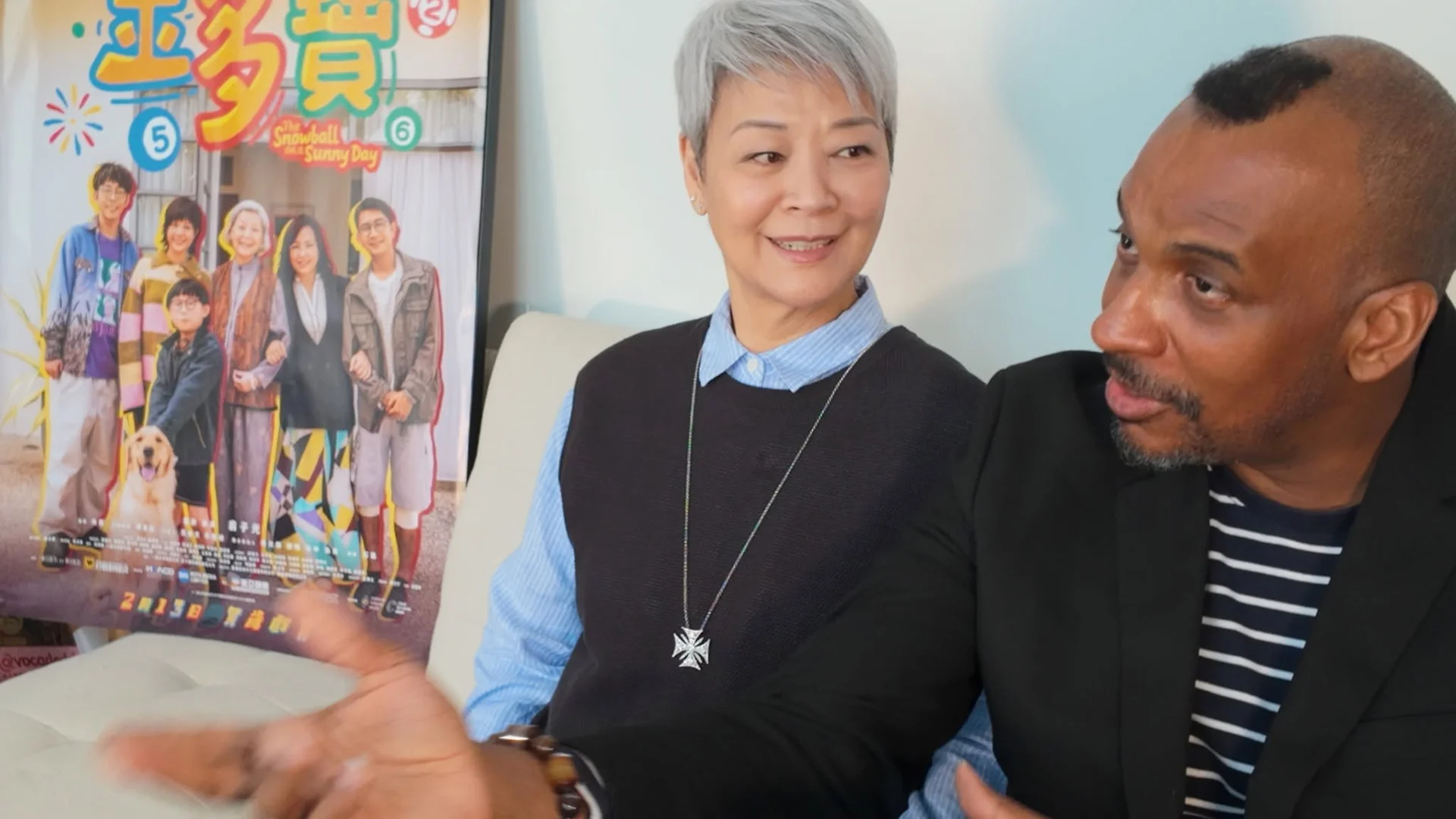
Since I began working as a film journalist in 2002, Hong Kong has occupied a very special place in my professional life. I have travelled there many times over the years, initially to conduct interviews and cover the film industry, and later as a documentary filmmaker, film consultant and researcher.
My latest three-week trip to Hong Kong, in March 2026, brought all these different aspects of my work together.
The trip was organised and financed independently, with several objectives: developing my film restoration and distribution projects, attending the Hong Kong International Film & TV Market (FILMART) and the Hong Kong International Film Festival (HKIFF), producing interviews for international home-video labels, and — perhaps most importantly for me personally — filming as much new material as possible for several documentary projects devoted to the history, evolution and people of Hong Kong cinema.
In other words, three very busy weeks.
Returning to Hong Kong with several projects
One of the professional objectives of the trip was to continue developing the international future of two restoration projects that are particularly important to me: The Black Magic with Buddha and the Whapung Films collection.
FILMART provided an opportunity to discuss these projects in Hong Kong itself, while continuing conversations concerning their future circulation, festival screenings and international distribution.
But restoration and consulting represented only one side of the trip.
I have been producing documentaries, interviews and archival features for home-video distributors for more than twenty years, and Hong Kong remains an invaluable place to continue that work. During this trip, I therefore also filmed new material for companies with which I have developed long-standing collaborations, including Arrow Video and Imprint Films, whose Imprint Asia line has become increasingly involved in the release and rediscovery of Asian cinema.
I cannot reveal all of those projects yet — the distributors themselves will announce them when the time comes — but several of the interviews recorded during the trip should eventually appear alongside forthcoming releases.
Three weeks to record as much as possible
Alongside these commissioned projects, I had another objective: to use those three weeks to build a substantial new body of interviews for my own documentaries and audiovisual archive.
This is something that has become increasingly important to me.
I have been interviewing people from the Hong Kong film industry for more than two decades, and today I want not only to continue that work, but also to connect these new conversations with the hundreds of hours of material I have already accumulated.
Rather than concentrating on a single documentary, I deliberately approached the trip as an opportunity to explore several interconnected aspects of Hong Kong cinema.
Among the subjects discussed were Hong Kong crime cinema, action and martial arts filmmaking, the Girls with Guns cycle, independent production, the changing economics of the local industry, socially engaged filmmaking, and the emergence of a new generation of Hong Kong directors.
The idea is to gradually transform these conversations — together with material from my existing archive — into documentaries, video essays and other projects for this website, CineFlamme and CineMagma.
Preserving memories, but also looking at the present
One of the dangers when discussing Hong Kong cinema internationally is to treat it exclusively as a cinema of the past.
The extraordinary period of the 1970s, 1980s and 1990s naturally remains essential to my work, but I am equally interested in understanding what Hong Kong cinema is becoming today.
This trip therefore allowed me to meet both veterans of the industry and filmmakers and producers involved in its current transformation.
I spoke with Hong Kong-based film specialists Arnaud Lanuque and Mike Leeder, whose knowledge and first-hand experience of the industry provide another perspective on its history and evolution.
I also interviewed former Milkyway Image production manager Ding Yuin-shan, who is now involved in independent film production, including the horror film Possession Street. Conversations such as this are particularly valuable to me because they create a bridge between the Hong Kong industry I began documenting more than twenty years ago and the one that exists today.
Director Jack Lai also spoke with me following his work on Possession Street, and also Back from the Past, providing another perspective on contemporary commercial Hong Kong filmmaking.
Revisiting careers and forgotten histories
Other encounters allowed me to continue conversations and research that began many years ago.
I interviewed Susan Shaw again (I know her since 2005), recording new material about filmmaker Li Han-hsiang and other aspects of her long career. Some of these conversations are connected with forthcoming international home-video projects, while others will hopefully feed into documentaries I have been developing independently.
I also had the opportunity to speak with veteran actress Elaine Jin. Rather than trying to make her reconstruct distant memories of films she understandably no longer remembers in detail, our conversation also looked towards her more recent work, including The Last Dance and The Snowball on a Sunny Day, a warm family film in which she gives a wonderful performance.
These encounters are important precisely because an archive should not simply freeze people at one moment in their careers. The history continues.
Documenting Hong Kong action cinema from the inside
One of the great pleasures of the trip was recording an extensive conversation with Chin Ka-lok, whose career encompasses several decades of Hong Kong action cinema as an actor, stunt performer, action choreographer, director and producer.
His personal history intersects with an extraordinary number of people, films and transformations within the Hong Kong industry. Talking with someone who has experienced this cinema physically — performing, coordinating and creating action alongside some of its most important figures — offers a kind of testimony that cannot be reconstructed from books or databases.
His involvement as producer of the documentary Kung Fu Stuntmen also makes his perspective particularly interesting: he is not only part of that history, but has himself contributed to preserving the memory of Hong Kong’s stunt community.
This is exactly the kind of first-hand testimony I want to continue recording.
An archive for future documentaries
Not everything filmed during these three weeks belongs to the same project, and that is intentional.
Some interviews were commissioned for forthcoming Blu-ray releases. Some relate to documentaries I have already been developing for several years. Others began simply because an opportunity arose to sit down with someone whose experience deserved to be recorded.
Over time, however, these individual conversations begin to connect.
An interview about action cinema can eventually become part of a documentary about Hong Kong stunt performers. Another conversation may contribute to a project about Girls with Guns, crime cinema, independent filmmaking or a particular director. Material filmed twenty years ago can suddenly find a dialogue with something recorded in 2026.
This is increasingly how I see my documentary work: not simply as a succession of isolated films, but as the construction of a long-term audiovisual history of Asian cinema based on first-hand testimony.
More interviews, more stories to come
It would be impossible to introduce everyone I met and every subject we discussed in a single article.
Over the coming months, I will gradually present more of the interviews recorded in Hong Kong, along with extracts, photographs, behind-the-scenes material and updates about the projects they will eventually become part of.
Some will appear through professional collaborations. Others will become part of my own documentaries, CineFlamme, CineMagma, or future articles on this website.
More than twenty years after my first interviews in Hong Kong, I still have the same desire to meet the people who make its cinema, listen to their stories and preserve those conversations.
The difference is that today I also have more than two decades of my own archives with which those new voices can interact.
And there are still many stories I want to tell.