
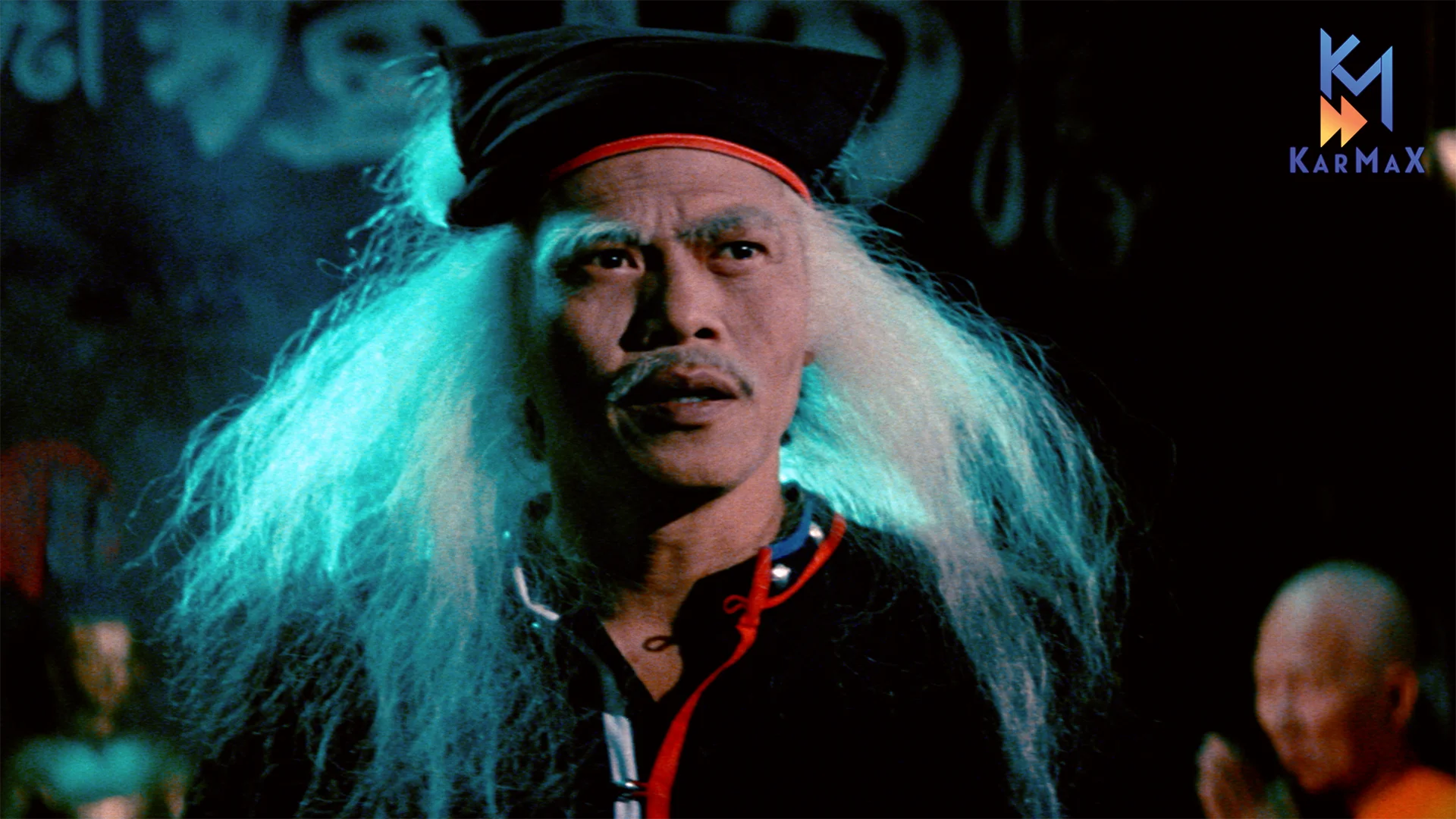
In 2023, I began working on what initially seemed like a relatively straightforward project: bringing back into circulation a largely forgotten Hong Kong film directed by and starring Lo Lieh, The Black Magic with Buddha (1983).
It soon became something much more complicated — and much more fascinating.
Produced independently from the major Hong Kong studios of the period, the film had virtually disappeared from circulation for decades. There was no readily available master, very little surviving documentation and, at first, no certainty about exactly what film materials had survived.
Working with the trust and support of worldwide rights holder Karmax-910, I began researching the film and its surviving elements. What followed has become one of the most challenging — and rewarding — film heritage projects I have undertaken.
Finding the film again
The first major step was locating the surviving original film elements in Hong Kong.
Fortunately, a substantial amount of material had survived: original film elements for the feature itself, as well as material relating to the original theatrical trailer and deleted footage.
The elements were scanned in 4K in 2024 by L’Immagine Ritrovata Asia in Hong Kong, providing the foundation for the restoration.
But scanning the film turned out to be only the beginning.
As we started examining the material in detail, it became clear that The Black Magic with Buddha did not survive in just one definitive form. We were dealing with two different versions of the film, in Mandarin and Cantonese, with differences in editing, footage and structure.
What had begun as the restoration of a single film therefore gradually became the reconstruction of two distinct versions.
Reconstructing two versions
The restoration work continued throughout 2025, in collaboration with French distributor and restoration partner Le Chat qui Fume.
The Mandarin version provided the basis for the first restoration work, while reconstructing the alternative Cantonese version proved considerably more complicated. Some material was incomplete or missing from the surviving original elements, requiring us to look beyond conventional archival sources.
This is where the project became a genuinely collective effort.
Additional material was eventually located with the invaluable assistance of collectors, particularly Toby Russell, helping us restore footage that otherwise might have remained unavailable.
It is an important reminder of something I have learned repeatedly while working with older Asian films: sometimes the survival of a film depends not only on archives and rights holders, but also on the knowledge and dedication of private collectors who have preserved materials for decades.
A film with almost no surviving documentation
Another challenge was the extraordinary scarcity of original promotional material.
Although film elements had survived, we could find no conventional press kit and virtually no original production documentation. Even locating period publicity stills proved difficult.
Here, Colin Geddes provided invaluable help by locating original vintage promotional photographs connected with the film.
These discoveries may seem secondary compared with finding a negative, but they are an important part of reconstructing the history of a film. Restoration is not only about repairing images and sound: it is also about rebuilding the context surrounding a work that has effectively disappeared from public view.
From restoration to the big screen
While restoration work was still underway, the film finally began returning to cinema screens.
A work-in-progress restoration of the Mandarin version was presented at L’Étrange Festival in Paris, followed by screenings in Nashville and at the Bangkok International Film Festival.
Seeing audiences experience the film again after so many years was particularly rewarding — especially knowing how unlikely such screenings would have seemed when I first started searching for the surviving materials.
The longer-than-anticipated restoration process has also had an unexpected advantage: it has given me time to considerably expand the historical material surrounding the film.
Giving the people behind the film a voice
One of my priorities with film restoration is to preserve not only the film itself, but also the memories of the people who made it.
I was therefore particularly happy to record a new interview with legendary martial arts actor Chen Kuan-tai, the film’s leading actor. My warm thanks go to Arnaud Lanuque, who was able to film Chen Kuan-tai at his home in China for the project.
I also had the opportunity to record an extensive interview with the film’s original producer, Gracy Tong Ka-lai.
Her testimony is particularly valuable because The Black Magic with Buddha is not necessarily a film she remembers with great affection. More than forty years later, however, she generously agreed to revisit the production, explain the circumstances surrounding it and discuss why the experience became one she had largely preferred to leave behind.
I am especially grateful to her for trusting me with the film and allowing this unusual chapter of her career — and of Lo Lieh’s career as a filmmaker — to be rediscovered.
These interviews are intended to accompany the restored film on its forthcoming home-video editions and provide audiences with something that did not previously exist: first-hand testimony about the making of this very obscure production.
A genuinely collaborative restoration
Although I initiated and supervised the project, The Black Magic with Buddha could never have been brought back through the efforts of one person alone.
I would particularly like to thank Karmax-910 for its continued trust and support; L’Immagine Ritrovata Asia for the 4K scanning of the surviving film elements; Le Chat qui Fume, which has undertaken the restoration and will release the film in France; and Mondo Macabro, whose early enthusiasm for the film helped give the project international momentum and which will bring it to audiences in North America.
My thanks also go to Toby Russell, Colin Geddes, Arnaud Lanuque, Chen Kuan-tai and Gracy Tong, and to everyone else who has contributed material, information, expertise or time along the way.
Film restoration is sometimes described primarily as a technical process. Projects like this remind me that it is just as often a process of investigation, collaboration and persistence.
Coming soon
The restoration has taken considerably longer than originally anticipated, but there is a good reason for that.
Instead of simply releasing the version we initially expected to find, the project has grown to encompass two versions of the film, recovered footage, archival material and newly recorded interviews.
The objective is not simply to make The Black Magic with Buddha available again, but to bring it back in the most complete and historically meaningful form possible.
After more than forty years in obscurity, Lo Lieh’s strange and fascinating film is finally finding its way back to audiences. And there is still more to come